A history of Black-owned businesses in the US
What you'll learn:
Black‑owned businesses have shaped America’s economic story for generations, overcoming barriers while driving innovation and community growth. This article highlights key historical milestones and today’s expanding network of grants, directories, and support systems empowering Black entrepreneurs. Keep reading to explore the full journey and discover resources built to help Black businesses thrive.
In this Article:
- Funding and recognition for Black-owned businesses
- A Golden Age of Black-owned businesses
- Black Wall Street
- African Americans in insurance
- Resources for supporting and growing Black-owned businesses
- A timeline of African American entrepreneurship
- Frequently asked questions
Black-owned businesses have a long and rich history in the United States. But today minority-owned businesses have a harder time getting access to capital and therefore have higher rates of failure compared to white-owned businesses. To put things in perspective, Black-owned businesses have been twice as likely to shut down because of the pandemic compared to small businesses overall.
In today’s economic environment, young Black business owners and Black American business owners can find new opportunities through targeted support programs and grants, which are especially vital for Black female business owners, Black women business owners, and all Black business owners in America to thrive.
Funding and recognition for Black-owned businesses
The plight of minority businesses in the US is finally being recognized and addressed. The Biden administration is promising to put $30 billion into a Small Business Opportunity Fund for minority-owned businesses. Perhaps even more encouraging, in the wake of protests for social justice in 2020, companies like Citi and JPMorgan Chase pledged millions of dollars in funding to uplift Black and Hispanic-owned businesses. These actions are the first steps on a long road to equitable opportunity for all businesses.
Adequate recognition and funding for Black-owned businesses is a relatively new development, but the existence of Black-owned businesses is not. Even before emancipation, free and enslaved Blacks were starting businesses and finding innovative ways to gain autonomy in their lives.
Here is a brief history of Black-owned businesses in the US with a special nod to the impact African Americans have made on the insurance industry since the 17th century.
More people are now searching for Black business owner grants, and the momentum is creating a better ecosystem so that Black American business owners and Black female business owners can access funding tailored to their needs.
A Golden Age of Black-owned businesses
From about 1900 to 1930, there was a golden age of Black-owned businesses in the US. Because Jim Crow laws forced African-Americans to form more insulated communities separate from whites, it led to a boom in entrepreneurship. All across the country in urban areas where the majority of Black people lived, small businesses were popping up at record speed.
In 1900, Booker T. Washington founded The National Negro Business League, renamed The National Business League in 1966. The league supported Black entrepreneurs and helped them start and grow their businesses. Six hundred chapters were established across the US.
This legacy underscores the need to mentor young Black business owners and fuel their growth, and highlights why modern associations like Black Business Owners Association remain critical to empowering Black business owners in America today.
Black Wall Street
The emergence of an affluent Black community in the Greenwood District of Tulsa, Oklahoma at the turn of the 20th century was quickly nicknamed Black Wall Street, and it served as the perfect metaphor for the wave of entrepreneurial success by Black people intersecting with the blatant racism that was rampant in American culture and the judicial system at the time.
Today, Black Wall Street is remembered for the proliferation of Black businesses that dotted the streets of Tulsa’s Greenwood neighborhood, but also for the violent riots that led to its demise.
Because of laws prohibiting Blacks from patronizing white businesses, Black businesses, including clothing stores, salons, banks, and cafes, flourished in Greenwood due to a lack of competition. What ensued was a large migration of Blacks to the area from places like Mississippi and other southern states.
But in 1921, race riots broke out that destroyed the community and its businesses. When a white woman alleged that a Black man had attempted to rape her, white mobs protested outside of the courthouse to demand justice. This quickly turned to riots in Greenwood and the streets and buildings went up in flames. Three hundred people died and 800 were injured. The only people arrested that day for the violence were Black people. Local and national news outlets misrepresented the riots as an uprising of violent Blacks citizens.
The community never recovered.
Despite its tragic end, Black Wall Street remains an enduring symbol for Black business owners in America, especially Black American business owners who continue to seek resilience and recognition. Efforts to revive that spirit now often focus on supporting young Black business owners and Black women business owners in traditionally underserved communities.
African Americans in insurance
From as early as the 17th century, African Americans have been involved in the insurance industry. Of particular note is The North Carolina Mutual Life Insurance Company, which was established in 1898. It grossed a quarter of a million dollars by 1910 and is now known as one of the oldest and most prominent Black-owned insurance companies in the US.
Although there has been a steady decline in Black-owned insurance companies, organizations like the National African-American Insurance Association (NAAIA) seek to turn that around by empowering Black professionals in the insurance industry.
Our very own Hiscox Pan-African Employee Network works extensively with Dr. Leroy Nunery II, entrepreneur and author, to speak to our organization about the history of Black people in the insurance industry and how we can work to continue that legacy.
Resources for supporting and growing Black-owned businesses
Consumers and corporations looking to support Black-owned businesses now have more resources than ever to make informed purchasing decisions. Directories like the Official Black Wall Street, Black Owned Everything, and We Buy Black make it easy to discover Black entrepreneurs across industries from retail and restaurants to professional services and technology. Many cities have launched their own local initiatives, with chambers of commerce creating searchable databases of minority-owned businesses in their regions.
For entrepreneurs seeking capital, organizations like the National Black Chamber of Commerce, Black Business Association, and Operation HOPE provide mentorship, networking opportunities, and connections to funding sources specifically designed for Black business owners. These resources represent a growing ecosystem committed to closing the wealth gap and ensuring Black entrepreneurs have the support systems necessary to build sustainable, thriving businesses that can compete in today's marketplace.
A timeline of African American entrepreneurship
As we celebrate Black History Month in February – and all year long – we recognize the contributions that have been made to the American economy by the Black community. At the same time, we realize we have far to go as we work toward an economy that is equitable for all Americans. Check out this timeline of African American entrepreneurship that honors their long history as small business owners.
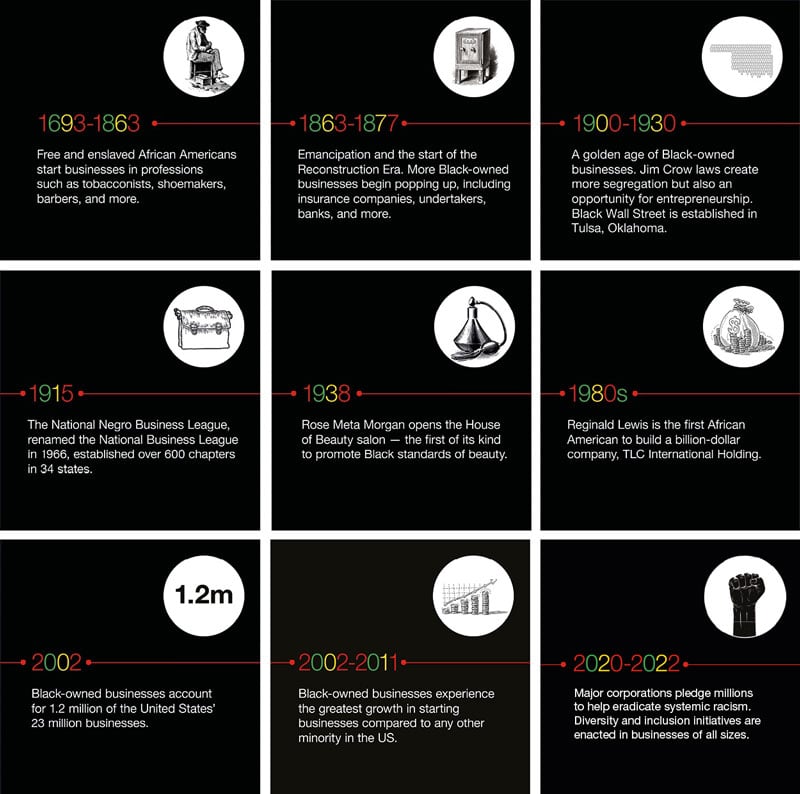
Learn more about how Hiscox supports Black-owned businesses and other diverse small businesses on our Small Business Insurance page.
Frequently asked questions
How many Black business owners are there in America?
According to the U.S. Small Business Administration, there are 3.5 million Black-owned businesses, employing over 1.2 million people across the country.
How many Black small business owners are in the US?
The Brookings Institution reports that 161,000 Black-owned employer businesses generate over $183 billion in revenue, employing 1.4 million people nationwide.
What percentage of business owners are Black?
According to this Pew Research Center survey, Black-owned businesses make up around 3.3% of all U.S. employer businesses, with a significantly higher share among sole proprietorships.
What grants are available for Black-owned businesses?
Black business owners can access numerous grant opportunities including the Amber Grant Foundation (monthly $10,000 awards for women), the NASE Growth Grant (up to $4,000), and programs through the Small Business Administration. Many corporations like Visa, FedEx, and Amazon also offer small business grants specifically for minority-owned businesses. Local chambers of commerce and state economic development agencies frequently launch grant programs with awards ranging from $5,000 to $50,000. Black entrepreneurs should regularly check resources like Grants.gov and minority business development centers for new opportunities, as application windows are often limited.
Related Articles
How we’re celebrating Hispanic communities beyond Hispanic Heritage Month
To celebrate National Hispanic Heritage Month, we’re shining a light on the Hiscox Latino Employee Network and the work they do at Hiscox and in local communities.
Read More
National Hispanic Heritage Month: Hiscox celebrates Hispanic and Latino entrepreneurs
Hiscox recognizes Hispanic and Latino business owners and entrepreneurs in honor of National Hispanic Heritage Month.
Read More
What Dolly Parton taught us about building a business that matters
Dolly Parton didn’t just build a career. She built a brand, a legacy and a lesson for every business owner.
Shine on
Dolly Parton didn’t just build a career. She built a brand, a legacy and a lesson for every business owner.
We provide tailored insurance for the specific risks you face, so you can take the right risks to grow your business.
Subscribe to the Hiscox Entrepreneurial Digest on LinkedIn


Get valuable business resources, timely tips and inspiring success stories in your LinkedIn feed every month.