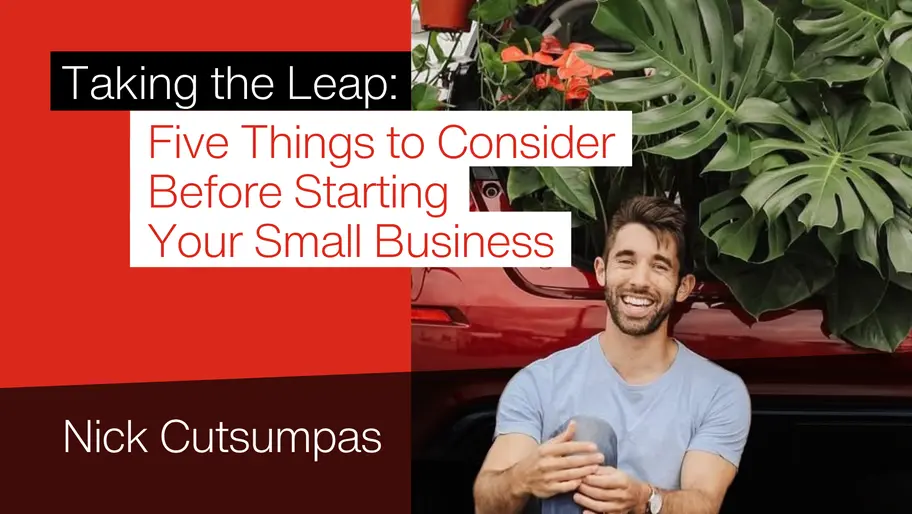
Taking the leap: Five things to consider before starting your small business
Any opinions, views, findings, conclusions, or recommendations expressed in this publication are those of the author(s) and do not necessarily reflect the views and policies of Hiscox.
A stranger across the world convinced me to quit my job and start my own business. Here’s the full story.
Before becoming a content creator and founding my own landscape and garden design business, I worked a corporate tech job in NYC. This is what most of my peers were doing after graduating from college and I was no different. It was a safe choice, but my parents, professors and mentors all said that it was the right thing to do. And for many people, it is. But pretty soon into my corporate career, I became disillusioned with the idea of working for someone else and not chasing my passion.
During those first six years of corporate life, I had grown my plant side hustle to the point where I had clients nearly every weekend; assessing their homes, taking them plant shopping and bringing their homes to life with greenery. It brought me fulfillment, a little bit of added income and most importantly, joy. But I never imagined that it would become my full time job and had no intention of leaving my well-paying startup. The thought would occasionally cross my mind, but the fear of paying NYC rent while taking a major pay cut was enough to scare me away.
That is, until I received a random DM on Instagram from a casting agent in England.
Apparently there was a plant-focused competition show being filmed in the English countryside, and the casting team wanted me to audition. I had built a modest following on social media, and the idea was both exhilarating and intimidating. I didn’t think I would get picked, but it couldn’t hurt to audition, right?
Three weeks later I received an email saying I had been accepted into the show, and would need to fly to England in a month. Was I in, or was I out?
I was in shock. I honestly never thought I’d make it this far, and now I needed to make a choice. Go on this crazy adventure that had the potential to catapult me into an entirely new career, or leave my stable, well-paying job with benefits.
I emailed the casting agent back and said thank you for the offer, but unfortunately I will decline.
The next day was just like every other. I woke up, took the subway to work and sat at my desk thinking if I had made the right decision. I wasn’t thinking long before my phone rang with an unknown international number. It was the casting agent.
“I’m not supposed to tell you this, but this show is premiering on Netflix and has the potential to change your life. Don’t make a mistake and turn this down.”
I accepted on the spot.
The next week I sat down with the head of my company and told her about this once in a lifetime opportunity. As a fellow entrepreneur, I’m sure she would understand my POV, and I asked her if I could take an unpaid leave of absence so I could return to my job after my time on the show was over. And then she said something I would never forget:
“Nothing is once in a lifetime. You’re doing so well here and should stay.”
I quit the next week.
It all happened far sooner than I expected, but her comment didn’t sit well with me. This show might be my one opportunity, my one wave, that could alter my life trajectory entirely, and I wanted to at least be given the opportunity to ride it. I wasn’t some massive risk taker, but I wanted to prove her wrong and knew I had developed the tools and startup savvy to launch this business and give it a fair chance to grow.
My family had a similar opinion. They were excited but terrified for me at the same time. Some probably thought I was crazy to leave such a great job to, as one of my cousins stated, “play in the dirt.” But their doubt only motivated me further, and I reassured them that I could always go back to the corporate world if things didn't work out.
Win or lose, I was prepared to handle any outcome, and I flew to England with a dream and a, not so secure, plan.
Seven years later, I am sitting in my greenhouse writing this post as a full time garden designer and content creator. It’s amazing to think back on my journey to becoming a plantrepreneur, and I owe it all to the casting agent. He had the courage to break protocol and be candid with a complete stranger, and if he hadn’t made that call, I may still be sitting at that desk today.
I’ve had time to reflect on what it means to take a big career risk, when is the best time start your own business and how you should go about it, and I’ve put together my top five pieces of advice when it comes to taking the leap yourself:
1. Interview other entrepreneurs
Before you let go of your steady paycheck and stability to start your own business, spend time with friends or mentors who are already in the throes of small business ownership. Ask them to be real with you, and give you the unfiltered versions of their day to day life. I guarantee you that they will say that it is less glamorous than it looks. Ask what surprised them most, what nearly broke them, and what they wish they had done differently.
What you’ll soon realize is that owning and operating a small business is like running a marathon without any guides marking the path. Some days feel like progress, others feel like wandering in circles.These conversations will get you focused, and although they won’t eliminate uncertainty entirely, they’ll help you stay on track. You’ll notice commonalities and similarities in how they operate, and once you identify those patterns, you can look yourself in the mirror and ask if you can accomplish those things too.
2. Protect your business
When you’re thinking of starting something new, it’s tempting to focus only on the exciting parts like the branding, the client deals and the creative work. But underneath every thriving business is an operational foundation that most people never see, or in my case, purposely avoid until the last minute because it isn’t “the fun stuff”.
Elements like legal, accounting and insurance can often fall by the wayside in the beginning of your entrepreneurial journey, which is why it is imperative that you lock those elements in before you really make the leap and start your business.
For me, that was getting insured with Hiscox’s small business insurance. Going into and performing physical work in client’s homes and office spaces is full of potential risk and liabilities, and being insured early in my business’s life cycle was essential. It gave me the confidence I needed to take risks and be creative, and COIs were essential for every larger project we took on.
Without that protection, our opportunities to generate revenue would have been limited.
3. Be prepared to pivot and prune
One of the hardest lessons in entrepreneurship is learning that not every idea you have deserves, or is going to survive. When you are thinking of starting a small business, you may have one cornerstone idea that seems infallible. After all, you invested time, energy, and belief into it, and letting go can feel like admitting failure.
But trust me, when it comes to making a living as a small business owner, hold every idea loosely.
Some things simply won’t work out the way you expected. Maybe a service doesn’t resonate, a product doesn’t sell or a strategy falls flat. Holding onto it too long out of pride or stubbornness only drains your time, energy and resources.
Thus we must learn to prune. Pruning in the plant world is not only about getting rid of something, but making room for new growth and moving in a different direction. Before making the entrepreneurial leap, you must be prepared to put your ego aside, stay humble and pivot and prune when necessary.
4. Prepare for inconsistent income
One of the biggest adjustments when leaving a traditional job is the unpredictability of income. In a corporate role, your paycheck arrives like clockwork. Consistency is a beautiful thing. Income from your entrepreneurship pursuits is inherently more volatile.
Even though I make a decent living doing what I do, every year, every season, every month is completely different. There will be months where everything clicks and deals are growing like weeds, and other months the business looks like an empty raised bed; full of potential but with nothing sprouting. It’s during those quieter months that you will be tested, and you have to make sure that you and your family can handle those fluctuations both financially and mentally.
The key is preparation. Before leaving your stable job, build a financial cushion if you can. Know your runway for your basic needs and try not to dip into savings too much if you can avoid it. Of course an angel investment or loan from friends or family can help kickstart the business, but can create a lot of pressure and potentially strain relationships.
Be as scrappy and self-sufficient as you can if you want to bootstrap your dream on your own.
5. Set a career shot clock
Dreams of being your own boss and running a small business are powerful, but without structure and guardrails in the very beginning, they can drift off course. One of the most helpful things I did when deciding to leave my corporate job was giving myself what I called a “career shot clock.”
In the game of basketball, a shot clock is the amount of time given to the offensive team to shoot the ball. Without it, teams would likely hold the ball for long periods of time and not be as inspired to act with a sense of urgency. My career shot clock was a little different.
I gave myself a full 12 months to launch my full time plant business and see if I could generate enough income to live on my own. If after the 12 months I was unable to accomplish that goal, I would close up shop and look for another 9-5 job.
This wasn't about creating pressure just for pressure’s sake. It was a constraint designed to give me focus and sharpen my decision-making. It also kept me honest, and each month I would check in with myself and ask: Is the business growing? Am I gaining traction? Do I see a realistic path forward?
I’d rather set a career shot clock and fail, than never have taken the leap in the first place.
Related Articles
Do you need a business license?
Starting a business is a busy and exciting time. But you may be wondering if you need a business license, and if so, what kind of business license. Here are some of the licenses a new business might need.
Read More
6 steps to becoming a successful CrossFit gym owner
If you have a love of fitness or are interested in CrossFit, discover what's needed and required to open your own CrossFit gym - including affiliation requirements and fees.
Read More
The Starting a Business in California Checklist
Starting a business in California can be exciting. To hit the ground running, it is important for you to complete certain steps so that your business is set up legally and protected from the day you open your doors. If you are planning to move to the Golden State to open your small business, here is a checklist to help you make sure that you have taken care of everything.
Read MoreWe provide tailored insurance for the specific risks you face, so you can take the right risks to grow your business.
Subscribe to the Hiscox Entrepreneurial Digest on LinkedIn


Get valuable business resources, timely tips and inspiring success stories in your LinkedIn feed every month.