Aging in Place Services: Greg Cantori's Journey



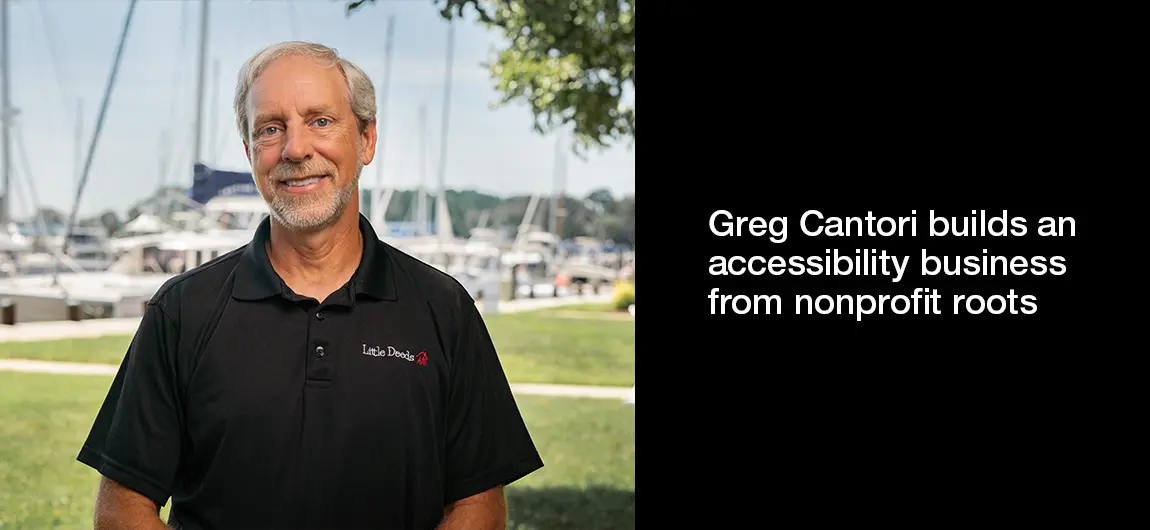
In this episode, Sanjay speaks with Greg Cantori, founder of Little Deeds Accessibility Solutions, about how his background in the nonprofit sector led him into the construction space, and ultimately to building a growing accessibility-focused business.
View transcript
Aging in Place Services – Greg Cantori, Little Deeds
[00:00:00] Sanjay Parekh: Welcome to The Side Hustle to Small Business Podcast, powered by Hiscox. I'm your host, Sanjay Parekh. Throughout my career, I've had side hustles, some of which have turned into real businesses, but first and foremost, I'm a serial technology entrepreneur. In the creator space, we hear plenty of advice on how to hustle harder and why you can sleep when you're dead.
[00:00:22] On this show, we ask new questions in hopes of getting new answers. Questions like, how can small businesses work smarter? How do you achieve balance between work and family? How can we redefine success in our businesses so that we don't burn out after year three? Every week I sit down with business founders at various stages of their side hustle to small business journey.
[00:00:43] These entrepreneurs are pushing the envelope while keeping their values. Keep listening for conversation, context, and camaraderie. Today's guest is Greg Cantori, the founder of Little Deed's Accessibility Services, a family business designed to help your family age in place gracefully. Greg, welcome to the show.
[00:01:07] Greg Cantori: It's been really great. It is really great to be here.
[00:01:10] Sanjay Parekh: So I'm excited to have you on because honestly, the things that you're doing, hopefully all of us need because we can all age kind of gracefully in place, in the places that we want to live and be. Before, but before we start talking about that, give us a little bit about your background and what got you to where you are today.
[00:01:27] Greg Cantori: And just what you just said there, all of us need it. I'll talk more about that because it's true. We all need this. I love it. My background has been nonprofits basically from the time I got out of college.
[00:01:36] I just love working with nonprofits. I love help helping people. Social justice issues. I was a homeless services nonprofit executive director. Did that for about seven years and then also headed up a sailing center in Baltimore City. Did that for a while, as well as heading up a foundation where I was able to give away other people's money, which I got to tell you is so much fun.
[00:01:59] So two and a half million dollars a year, and I had my own discretionary fund of about $80,000 that I could spend the way I wanted to. To help nonprofits do their good work. That led me to the State Association of Nonprofits, Maryland Nonprofits, which is the largest state association of nonprofits in the United States. And we also did created something called the Standards of Excellence. Nonprofits exist by their reputation. If you have a poor reputation, you don't get donors, you don't get grants, your whole thing falls apart. And so we created these standards in order to. Raise the level of ethics and accountability, including board service, what they do and so on.
[00:02:42] So that when you see that seal standards of excellent seal, you know that's a good nonprofit. You know, you can trust what they're doing. And that then led me to where I am now, which is a semi-retirement starting Little Deeds that you just mentioned.
[00:02:57] Sanjay Parekh: Yeah. So is, it sounds like this is the first kind of entrepreneurial venture you've ever undertaken.
[00:03:04] Greg Cantori: That's somewhat true. Yes. Okay. I did do a little bit of a housing contracting work in between jobs and that gave me a little taste for what it might be like to run a business. But I decided to go all in because I'd been challenged by my board saying that, Hey, you don't know how to run a business. You just know how to run a nonprofit. I said, let me show you. I think we can run a business.
[00:03:28] Sanjay Parekh: Okay. So how long has it been running Little Deeds now?
[00:03:32] Greg Cantori: Eight years. Eight years, okay. Yeah. Eight years of running that. And so I made the magic five year mark. Yeah. And we're still alive and kicking, so I think we would call ourselves successful. If you can keep a business alive for eight years you're pretty. Okay.
[00:03:47] Sanjay Parekh: Yeah.
[00:03:47] Greg Cantori: And yeah, so we, we made it through the thresholds in there and now I'm out here in Spain talking to you from Spain, and we are now pivoting Little Deeds into a national. Association and I can tell you a little bit more about that.
[00:04:02] Sanjay Parekh: Okay. So before we get into that why. This idea why this area? Why, what was it that attracted you to this?
[00:04:11] Greg Cantori: Throughout my career in nonprofits and this is important for the listeners too to understand is that it, when you're really passionate about what you're doing. A lot of times the dollars will follow. So I just was really passionate about social justice. Homeless have always been in our country, have always been looked down upon, frankly, and as a moral failing, personal failing. And so, and not understanding this systemic issues that creates homelessness and to be able to help them rise above where they've been.
[00:04:46] These are individuals that have hit the lowest of the low. I mean you're on the street, you have no family, no friends, nothing, and you're getting. Services when you can, you're trying to find food and so on. To be able to go from that to what we were able to help them with, which was moving into a home, reconnecting with their family, renting an apartment. And what we actually piloted and trademarked was a home ownership program using the Habitat for Humanity model. But to be able to take all of that and to see this individual grow and to stay friends with them for those years that they did that, there's nothing better than that. And you go to bed at night.
[00:05:24] And you know that you just got somebody off the street and they actually own their home now I what better thing in life? I mean, that's just so awesome. And with a sailing center, the same thing. To be able to take someone who had a disability who is indoors most of the time, to be able to put them on a sailboat and we had trouble bringing them back in. A lot of times they'd go out there, we'd have to go in a chase boat and chase them down. And because they were having so much fun out there sailing and doing that. We had a blind sailing team, which was a whole revelation about what the human capacity is for change and adaptation. They taught us more than we ever taught them.
[00:06:04] Sanjay Parekh: Yeah.
[00:06:05] Greg Cantori: They taught us about how to feel the sun in the face and the wind, and to be able to hear the sound of the wharf and the dock as we got closer. And when they had sunglasses on, we all had sunglasses on. You forgot who was blind.
[00:06:18] Sanjay Parekh: Yeah.
[00:06:19] Greg Cantori: That's was just the most amazing thing, so, so that's the common theme leading to Little Deeds where I wanted to see if we could go ahead and help people who were low income seniors in particular, a very challenging population because there's very few programs that will help fund what we needed to do, find the funding that we needed on that, and then. Pivot that into a profitable business.
[00:06:44] Sanjay Parekh: I like it. Okay, so let's talk about that then. So it's been eight years, so clearly it's been profitable to some extent. How did you manage that process? Like where did it hit each one of those years? How did you fund it initially and kind of ongoing then?
[00:07:01] Greg Cantori: We grew. This was another little challenge. Instead of saying, Hey, you know, go ahead and give me $500,000 and let's get started. We literally just started dollar by dollar. So we literally worked out at the back of a not even a pickup truck, it was just a it was a hatchback. It. And yeah, so we actually had a ladder on top and the tools inside and myself and my son-in-law and a helper and we would meet at the job site and start work that way.
[00:07:30] And we sometimes we'd even park the vehicle out of sight of the customer's eyesight, so they wouldn't see, they were showing up in a regular car. And by earning enough money there, we were able to purchase a pickup truck and a van. And so we grew organically as the profits proved that we could move on. So we didn't take on debt. That was one of my criteria. I wanted to see if we could do this organically with minimal or no debt and turn the profits back in the other option. The other issue there was to take those profits that we did make and use that to subsidize our low income clients that couldn't afford to pay us. We, we often would do work for folks that they didn't know they were getting charity, but they were, and one example, being a blind woman who needed to grab bars in her bathtub and some extra bright lighting, she could see light and dark. And the total bill came to about $1,400, but we charged a $300.
[00:08:29] Using our own money for the balance on that. And here's the funny thing about it. We knew that she didn't know it was charity. She looked at the bill, well she looked at it on her computer because she was blind and she said $300, things are getting so expensive now. And we were, it is like, yeah, it's too bad and you know, it's inflation just the way it is. And she never knew.
[00:08:49] Sanjay Parekh: Yeah.
[00:08:50] Greg Cantori: She never knew.
[00:08:50] Sanjay Parekh: Yeah.
[00:08:51] Greg Cantori: So, yeah.
[00:08:51] Sanjay Parekh: So, okay. So let's talk. So it sounds like you didn't put much money or any money into the business to start didn't take on debt. So it's kind of wholly owned at this point. How did you scale revenue then over time, and how did you manage that balance between kind of the full price customers and the ones that were getting help?
[00:09:12] Greg Cantori: That's, so we would use our discretion for the ones that needed help. Because a lot of times having a nonprofit background, I know a lot of times you have to do a tremendous amount of paperwork in order to get help, right? Yeah. You have to apply for grants, you have to apply for loan programs and so on.
[00:09:28] We didn't want to do any of that. We just wanted to be able to, on the spot, say, okay, we can tell that this individual's struggling financially, let's help them out. So we always had money and reserve for that on a discretionary basis. But we also had. In my phone book, I had people to call that I knew would have funds available when asked. And so that was also critical for our business success. So networking like crazy with the Department of Aging, the Department of Disabilities and a number of nonprofits that would also come, like the Rebuilding together nonprofits, habitat for Humanity and having them and basically ready to go if we came across somebody who needed their additional help.
[00:10:09] And then we could coordinate that. So we grew slowly, but we also were able to set aside enough funds to help individuals as we came across. And sometimes I'd even get bills passed actually where we've talked to legislators to go ahead and get a bond bill set in there so we could help them pay for things.
[00:10:30] Sanjay Parekh: Okay.
[00:10:31] Greg Cantori: Yeah.
[00:10:31] Sanjay Parekh: Yeah. I love it. So, okay, so the business over eight years scaled and now you're, there's like a handful of pivots here that we've got to talk about. One is pivoting the business to a national, the other is moving to a different country and still running this thing. So let's talk about the first one and then we'll move into the second one.
[00:10:52] So yes, how are you thinking about this and why did you think about moving this into a bigger thing?
[00:10:58] Greg Cantori: So here's what happened. It was an aha moment. Like a lot of businesses, we have aha moments, and the aha moment here was that we got a call from one of our current clients, and she said my, my husband fell with holding one of your grab bars.
[00:11:12] It ripped out of the wall and that was an emergency, you know, five alarm emergency. So go rushing over and find out that, yeah, sure enough, the grab bar had ripped out of the wall, but it wasn't one of the ones that we installed. She had decided to hire somebody else to install, even though we'd put in 15 grab bars in this one particular house. Because he was very weak and frail. And decided to save a little bit of money hiring a handyman who had no experience doing it. He used simple wall anchors that can only hold like 15 pounds. And put that in there versus the, what we did. The aha moment on that was number one, that was not our grab bar.
[00:11:50] And please make sure you hire us properly the next time. But the most important thing was, is that we need to have standards for grab bar installation. There's no national standards for it. It's a, anyone can do it. Anyone can do it any way they want to. It's sort of like installing seat belts in a car.
[00:12:05] Do it any way you want to. We don't allow that. Right. And the seat belts in the car is the analogy I want to use, is that we also realize that what are we doing going around and retrofitting houses when they should have been set up that way in the first place? All of us is, you know, one slip and fall away from a hospital visit. If we'd use too much conditioner in the shower and we close our eye, you got soap on our eyes, you got conditioner on the floor, and down you go. So the idea was let's make it. Like, like seat belts and cars. We don't have any exceptions for seat belts and cars. There should be no exceptions for grab bars and showers.
[00:12:44] And that's the pivot. The pivot was let's create a credentialing national standard that gives certification that also advocates for, very similar to what Ralph Nader did with unsafe at any speed. He's the one that got to grab the the seat belts and cars do the same thing. And make this a national standard that's mandatory.
[00:13:08] The real piece that really hit me is the 55 plus communities, and if anyone lives or has a loved one who lives in the 55 plus community, I bet you they don't have grab bars in those showers. And yet here are people that are 60, 70, 80 years old living in these communities. It's not mandated, they say 55 plus, but that's only a fair housing exception that has nothing to do with the standards of the building. It just a, it just basically says you have to be over 55 to live here. That's it. And no standards. So we're going to mandate that, that any 55 plus community has to have basic standards, grab bars, handrails, no thresholds, proper size doors, on and on. To make the house safe for anyone who visits as well as who lives there.
[00:13:55] Sanjay Parekh: So is this pivot into a national thing? Is this a business pivot? So you're going to do business everywhere or is it a advocacy pivot? We're going to advocate for these bills to be passed kind of locally, nationally.
[00:14:07] Greg Cantori: Much a business. Okay. Very much a business pivot. because we want this one. We want to be able to use the profits again to, to good use.
[00:14:15] Sanjay Parekh: Got it.
[00:14:16] Greg Cantori: And for folks who may not be able to afford grab bars and things like that. And then grab bars is our is the tip of the arrow. That's to get into the mindset that our homes are not safe and they need to be. And some examples, all the bells and whistles on our appliances like microwaves and so on. You, you would not believe this, but the number one cause of fires in the house is the stove. There's no automatic stove shutoffs required on any stove.
[00:14:45] Sanjay Parekh: Yeah.
[00:14:47] Greg Cantori: It's like, can and yet the device is less than 50 bucks to do that. And we install them. You can retrofit them, but people don't know that. So you can retrofit automatic shutoffs for stoves in case there's a stove fire.
[00:14:59] Sanjay Parekh: Huh.
[00:14:59] Greg Cantori: And so that's a great example. But that, but the grab bars are the easier one to get in because it's easier to install them. It's easier to advocate for them. And the other thing is that. Handrails on stairs are not required until you get up to step number three.
[00:15:15] Sanjay Parekh: Yeah.
[00:15:15] Greg Cantori: So the first three steps don't require handrails yet. The vast majority of falls are on the first step. So, I mean, I'm laughing about it. Yeah. But it's really bad. Yeah. It's like it's, I mean, there's actually viral.
[00:15:29] Sanjay Parekh: You should use the data to.
[00:15:30] Greg Cantori: Right. Right.
[00:15:31] Sanjay Parekh: Inform the decisions.
[00:15:33] Greg Cantori: Has everyone seen the viral videos of people falling out their front door? I mean, almost everyone's seen those now that there's these viral videos going around with a, with the ring cameras showing people literally being pulled out of the front door by their dog, or coming up the stairs and falling down because it's slippery. And it's it's because there's no handrails there, there's nothing to grab onto, so you just go right down. So the idea is that we need to do national standard, but we can make money through the certification process and also using grants and so on. Just like any good national advocacy group.
[00:16:09] Adam Walker: Support for this podcast comes from Hiscox committed to helping small businesses protect their dreams since 1901. Quotes and information on customized insurance for specific risks are available at Hiscox.com. Hiscox: business insurance experts.
[00:16:30] Sanjay Parekh: Okay, so let's talk about the other pivot because you're like, well, I'm going to do this hard thing, and while I'm doing that, I'm also going to do this other hard thing and leave the country and do it remotely. So talk about like that move of shifting to another country and then still running a business in the US and like the time zone differences. Like there's all probably like a million little things that end up happening. Like talk about the challenges that you faced in doing that and how you've kind of dealt with it.
[00:16:59] Greg Cantori: Well the real tests and this is part of what your discussion on here for a good business is being able to run without your day-to-day involvement.
[00:17:07] That you have such great managers, COO, bookkeeper, accountant, lawyer all the a team members are, they're all humming along and doing their job and doing it well because you have great standard operating procedures. That's another key thing. So we developed these amazing SOPs and we never wanted to become a franchise, but we could have. By doing the SOPs, we were able to go ahead and say, okay, it is running well. We could run remotely and I could move to Spain with my entire extended family, including my granddaughter. And that's what we did. So in about three months off to Spain, we went and we've been here three and a half months now.
[00:17:46] And my team remarks remotely. My, my COO lives on a sailboat, travels by sailboat. My, I have somebody in the Philippines helping out and yeah. You can do it, you can do it. And it's a key test to be able to understand that. The other piece is, and this is a strategic piece, is that a successful business is one that disrupts an industry.
[00:18:11] And you know I'm a follower of Alex Smith who's a strategist on LinkedIn. I highly recommend everyone looking them up. And that was another aha moment, is that you can compete in the red bloody ocean. Like handyman and someone that we've done in the past where you can move into an entire blue ocean area where there is no company, but also because you are creating a new process or disrupting an industry. In this case, we're going to be disrupting the home building industry, the remodelers industry, the real estate industry and even the insurance industry. So we're going to disrupt all of that through the mandatory application of grab bars and all showers, grab bar and every shower, a handrail and every step.
[00:18:56] Sanjay Parekh: Yeah. Okay let's dig into kind of this remote. So you've got a COO that's on a sailboat. You've got help in the Philippines, 24 hour kind of coverage, it sounds like, almost, because you've got people everywhere, but you've got to have people. On the streets to do the actual like work.
[00:19:15] You know, you can't do that remotely. That's right. When you've got somebody calling up saying, Hey, I need a hand a grab bar installed. So how do you manage those teams? Like when everything's fine and going Well, it's it's easy to deal with, but it's when problems erupt and arise, like, and they need to talk to somebody. And maybe you're asleep or you know somebody's not available. Like how are you managing that as a team to make sure everything goes smooth for your end customer?
[00:19:43] Greg Cantori: We have we had a, an amazing CSR customer service rep that would take calls on that and we can do things asynchronously. So even if the hours aren't quite right, there's ways to leave a message and follow up immediately.
[00:19:57] And of course, using technology with instant answers, with text messages and so on to do follow up as well works out. But. Yeah the heavy manager and a field crew leader that knows their stuff and can work in as independently as possible. Again, it goes back to the SOPs. If they know what's expected of them and what, how they're going to be ranked and rated and so on. You can do this, you can do it. It's interesting because most people think about remote work. They're usually thinking about technology and things like that. Not the hand on work. But you can do that as well. This. The entire construction industry is probably ripe for this kind of innovation.
[00:20:40] It's still very old school. It has a very poor reputation generally, especially the handyman area, unfortunately, because anyone can strap on a belt and put a drill in it and say, I'm a handyman, and go out and do it. So the idea of having standards standard operating, right, it's true.
[00:20:59] And that's how a lot of people do it. They're, yeah. You know, Mr. Fix it, do it yourself at home and Hey, I could do this as a business, and off they go. And so there's, you know, the entrepreneurial myth too is that just because you know how to fix a faucet or something doesn't mean you're going to be a good faucet fixer business owner. And so there's a lot to, to learn about the operations, but good SOP and modeling some other great SOPs that are out there would help tremendously on it even if you don't become a franchise. That's, that is my big aha moment.
[00:21:32] Sanjay Parekh: Yeah. I think the other. Part of that question is probably how do you find the right people?
[00:21:39] And is there something that you've done or you've realized along the way in eight years of like, who is the right fit generally, not specifically maybe for your business, but just generally, like are there any tricks or tips that you've realized over time of how do you find a good fit for your business?
[00:21:55] Greg Cantori: You know, you've probably heard the analogy of making sure the right people are on the bus in the right seats. So the other thing is, I don't really the bus doesn't necessarily need to know what direction it's going initially. Just get those right people on the bus. And how do you know they're the right people? So one of the things is during interview process, I like to listen to what their life philosophy is, what they're looking for in life, what makes them happy and satisfied. And if that aligns with what we're doing, like, do you want. Do you feel great about helping people who are older or people with disabilities?
[00:22:25] You know, and what would that do for you? What, you know, and you can get quickly. Good said. Or I hear stories where a lot of times they would just tell me a story, like, I was helping my grandfather with this and doing that. I said, okay you're the person. You're hired. And the other thing is that I always believe in attitude before aptitude.
[00:22:46] So if I get somebody with the right attitude, the aptitude can be taught. So that's the other thing. So if I got somebody with the right mindset, I can bring them on board and become an A player very quickly. And that's, it's, I've been very lucky. I've had some of the best workers. I've had very few. We, we had, of course everyone has one or two people you're going to have to let go. But most have been just spectacular. And it's because we have a shared vision, a shared mission, and it, some people have even told me that I would do this job for free if I could. And that's like, that's a really awesome, and I'm thinking that's the nonprofit attitude. The nonprofit attitude is that I love doing this so much. I am so passionate about it. I would, if I had a million dollars and I didn't have to work I was just showing up every day anyway.
[00:23:37] Sanjay Parekh: Yeah. Yeah.
[00:23:39] Greg Cantori: And so those are the kinds of things you can kind of get from someone if all they can talk about is the dollars. When do I get paid? When does this happen? When, then I, it is probably not the right fit for me.
[00:23:51] Sanjay Parekh: Yeah. Yeah. Let's circle back to something you said earlier of like, the whole reason you did this was the gauntlet was thrown down to you by your board members of, you don't know how to run a business, or you know you don't understand that benefit of, through this process of eight years, what has surprised you, not surprised you, that you've learned or you've brought from nonprofit or vice versa. You've now realized that from for-profit, you should take back into nonprofit.
[00:24:21] Greg Cantori: It. Well, one thing we learned is you ne you never stop learning and no matter how many years you have, and there's always something more to learn and the process on that and the gauntlet, by the way, was only a part of it.
[00:24:33] The real impetus behind this was the need. That was out there for people seniors aging and the people with disabilities not being able to get their homes modified. And that happened to my parents, it's happened to my friend's parents and so on. It their homes are just not safe enough for them.
[00:24:49] But that was the real, but yes, it said, can you do this as a business? And the learning that you go along there is that it's just continuous. I highly recommend any kinds of networking, professional networking groups that have an educational component to it about business development, business operations because all of us come with some strengths and total blind spots. And the blind spots are the ones that are going to hit you over the head with a two by four. And that's, it's going to be like, maybe you're not watching your financials, maybe you don't understand how to read a balance sheet and maybe you don't understand. You know the whole financial driver is that you need to be paying attention to all the metrics to know whether or not you're really going to be successful or not, or are you going to run out of cash, you know, how do you know you when you're going to run out of cash?
[00:25:40] So you need to know all of these things, and that's constant learning. But taking that back I believe that nonprofits, and this is what is a great thing, are becoming more and more entrepreneurial. You see a number of them and great, let's go back to Habitat's, a great example. They created something called a Restore.
[00:25:58] And a Restore is where they take donated materials and set it up and you get to go shopping there. And that money is a, basically a for-profit revenue source for a nonprofit to help low income home buyers. It's awesome. So they took a for-profit aspect of having these stores in the different cities and used that to funnel edit their nonprofit mission. So that's very entrepreneurial. In fact, I remember I meeting one, one guy of a restore. He used to run a giant food store. He was the manager. So he knew all about stocking shelves, where to put items so that people would buy them first, you know, where to put the the tantalizing thing near the door or the checkout counter. And he did that at the Restore and it was awesome. It, you go through here and it says, I want to, so I loved it. It's,
[00:26:47] Sanjay Parekh: Yeah, that's hilarious.
[00:26:48] Greg Cantori: Yeah, so I think that's it. Being more entrepreneur.
[00:26:51] Sanjay Parekh: Restore is a fantastic business. We have donated used home products lightly used home products there as well. And so hopefully they avoided the landfill and got some use for somebody else as well as. You know drove some revenue for Habitat, so that's fantastic. Okay, Greg, I've got a couple last questions for you. This has been super, super interesting, but thinking back now, it's been eight years.
[00:27:16] If you could go back in time and do something differently based on what you know now, what you've learned now over eight years, is there something that stands out to you and what is that and why?
[00:27:26] Greg Cantori: It does I would've gotten more people on the bus sooner. So the. I, my weakness was not having that standard operating procedure, not understanding how vitally important that was. I thought that, you know, the businesses up here, I know how things are going to run, and I see this com a common thread through so many small business owners. It's too much is in your own head. If it's there, it's not helping anyone. And if you can't exit the business, even if you don't expect to exit the business.
[00:27:58] In some way, then you don't really have that viable business. I didn't understand that the first couple years. So if I had a way, I would've said get those SOPs written right away. If, but that's one of your number one homework assignments when you start a business, is how are those operating procedures going to go? And they don't have to be perfect because they're constantly evolving. Mistakes are made. You go back you check it, you fix it, and there's so many great pieces of software to help you with that. Now the other thing is having a good operations person on top of the SOPs, so I belatedly hired the, an operations person and she just transformed what we did.
[00:28:37] Absolutely transformed it held more people accountable, held myself accountable. Held, you know, staff accountable and even customers making sure that you know, they understood what our processes were. So it, it was less shooting by the hip and more methodical. And I have always thought this is something a mistake that I think a lot of us make, that if you're so methodical, you can't be entrepreneurial. You can't be creative, and that's not true. It you, once you've got that methodology down, that allows you the time and the benefit to deviate. And practice something a little bit different and then bring that back to the business to see, hey, this is where actually worked. So that, those are some of the takeaways.
[00:29:19] Sanjay Parekh: I love it. Okay. Last question for you. If you're talking to somebody that's thinking about taking that leap and launching a side hustle or a small business, what advice would you give to them?
[00:29:30] Greg Cantori: I definitely do it. It's if you have the energy and the time you believe you have the time to do it, you've got to give it a try.
[00:29:38] One way to tip your toe into it is volunteer as a board member of a nonprofit that might be in that arena that you might be interested in. And one of the reasons I'm saying is that you'll get to see everything. You'll see the financials, you'll understand the ins and outs of how that group and that organization is running, and you'll be learning so much more than perhaps you're even benefiting them, actually.
[00:30:01] So that's a. Little secret sauce there is join a board and they will love you for it because they need great board members that are interested in it. So it's a really nice two-way street. And then you can use that as a, it also builds your resume. You can say, I was a board member of X, Y, Z, and that, that helps but it also helps you understand the business aspects before you leap a hundred percent yourself on that.
[00:30:26] And if you don't have strength and financials, serve on the finance committee. You knows maybe serve as a treasurer eventually. Learn how to do all that. And that way you can do it in a safe space before you go out and actually put your own dollars at risk.
[00:30:42] Sanjay Parekh: I love it. Greg, this has been fantastic. Where can our listeners find and connect with you online?
[00:30:49] Greg Cantori: Well, we still have Little Deeds up and running and so LittleDeeds.com and that's a great place to, to go ahead and send an email or follow through with me and we'll be soon launching our Grab Bar Installers Association of America website. And by the way, America is the first start, but we are going to become international in this. There's, I am here in Spain and Spain is even worse than the United States when it comes to accessibility. I love Spain. There's so many great things, but the accessibility isn't one of them. And but we're going to be looking at the UK, Spain, Australia, and New Zealand and so on as well because they also don't have standards for Grab Bars. But yeah, LittleDeeds.com.
[00:31:30] Sanjay Parekh: I love it. Greg, thanks so much for being on today.
[00:31:34] Greg Cantori: Thank you. It was really enjoyable.
[00:31:38] Sanjay Parekh: Thanks for listening to this week's episode of the Side Hustle to Small Business podcast, powered by Hiscox. To learn more about how Hiscox can help protect your small business through intelligent insurance solutions, visit Hiscox.com. And to hear more Side Hustle to Small Business stories, or share your own story, please visit Hiscox.com/side-hustle-to-small-business. I'm your host, Sanjay Parekh. You can find out more about me at my website, SanjayParekh.com.
Subscribe to our podcast



Did you start your business while working full-time at another job?
Tell us about it! We may feature your story in a future podcast.