Golf Deals E-Commerce: David Paxton's Journey



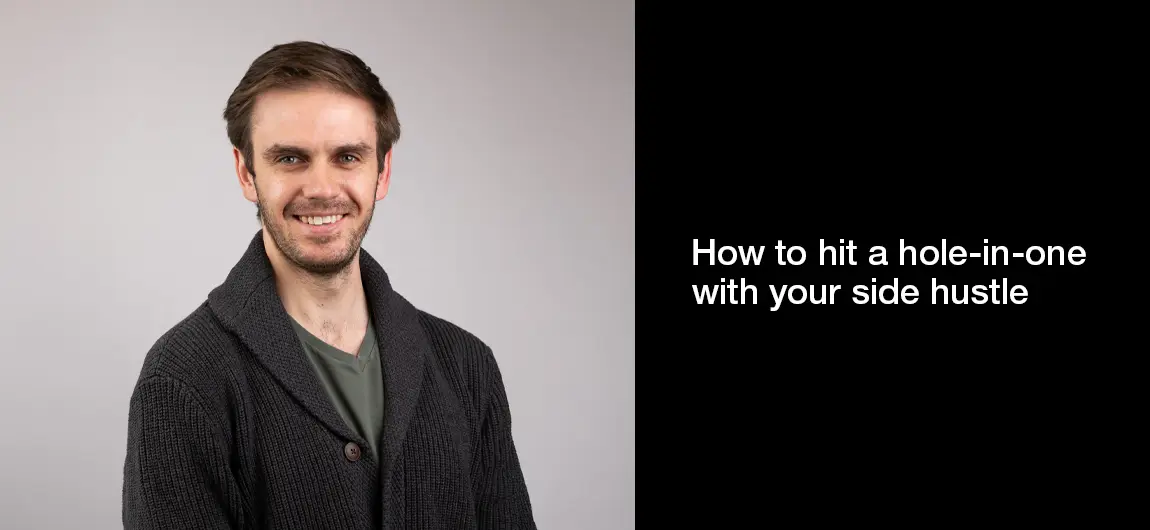
While browsing the Golf subreddit, David Paxton saw a lot of people posting deals on golf gear. Looking through these deals was fun, but it was also time-consuming if you were looking for a specific item. So Paxton created Daily Golf Steals, automating the deals to help golfers find what they wanted faster. He still runs the business as a side hustle while working a full-time job.
View transcript
Golf Deals E-Commerce – David Paxton, Daily Golf Steals
[00:00:00] Sanjay Parekh: Welcome to the Side Hustle to Small Business podcast powered by Hiscox. I'm your host, Sanjay Parekh. Throughout my career, I've had side hustles, some of which have turned into real businesses, but first and foremost, I'm a serial technology entrepreneur. In the creator space, we hear plenty of advice on how to hustle harder and why you can sleep when you're dead.
[00:00:21] On this show, we ask new questions in hopes of getting new answers. Questions like, how can small businesses work smarter? How do you achieve balance between work and family? How can we redefine success in our businesses so that we don't burn out after year three? Every week I sit down with business founders at various stages of their side hustle to small business journey. These entrepreneurs are pushing the envelope while keeping their values, keep listening for conversation context and camaraderie.
[00:00:55] Today's guest is David Paxton, the founder of Daily Golf Steals an e-commerce site focused on helping you find the best deals on golf gear. David, welcome to the show.
[00:01:06] David Paxton: Thank you. Thank you for having me.
[00:01:08] Sanjay Parekh: So I'm excited to have you on. Um, even though I will fully admit right now, I am not a golfer. But I don't think that's gonna hinder our discussion because I think there's a lot of interesting aspects of your business. But before we get in there, give us a little bit about your background and what got you to where you're today.
[00:01:24] David Paxton: Absolutely. So originally from UK, specifically Scotland, so all my family's still over there. Uh, so I have both that combination of love of golf and saving money in my blood, which has been partially the, the undertone and how I've got to, to where I am.
[00:01:37] Um, been in the US going on 20 years now, including studying at University of Virginia where I, I focused on finance and then also a focus in entrepreneurship, which really sparked some of that interest, sparked some of that, uh, background that's got me to where I am today. My professional experience is in a combination of management consulting and then also corporate strategy and operations at a FinTech company.
[00:02:01] And then I love to stay busy, so I've started a few side hustles on the side. So that's kind of my professional side. I'm a pretty poor golfer. For those who follow golf, I think my handicap, I would describe as a gentleman 16. Um, so my ability to find a great deal is a lot better than my, my passing ability. Certainly.
[00:02:18] Sanjay Parekh: Better to find a great deal than finding the hole on the golf course it sounds like. And what's interesting to me is, so you uh, we were talking before we started recording, you actually grew up in Edinburgh, which is the birthplace of golf. So this is a very natural, merging of kind of family history or, or like absolutely history of you as, as well as the other part I love is finding a great deal because man, I am a deal hound. I love the good deal. So, um, you are speaking my terms right there. So, um, was this, uh, so it sounds like you've done some side hustles before. How many before this or, or was this the first one that's kind of really taken off?
[00:02:59] David Paxton: Yeah, so I'd say this is the first one that's really taken off. Uh, but a couple in the line here. So one while I was at university, actually started a nursing recruitment website. Interesting. So this was all about trying to help new graduate nurses find their first jobs. So everyone thinks there's a nursing shortage. It's really easy to find the that next role. That's true if you're 2, 3, 4 years into the job when you're first coming outta school, you still need a bit of training. You need handholding, kind of that apprenticeship model where there was a lot of nurses graduating, not a lot of roles, and hospitals would open and close applications in their day because they would get all that they needed to find them.
[00:03:33] And what I essentially built was a bit of a directory. That helped nurses know which hospitals were hiring, when, where, what did you need to submit? Where's the link? Who's the hiring manager? I made that available for free to nurses, and that was kind of both the bit of experience building websites, trying to get my hands dirty in terms from technical, uh, technical skills.
[00:03:53] And then also the affiliate site, which is also how we monetize Daily Golf Steals where we would drive traffic to Indeed and others. And that'd give us a, a cut off of revenue that they earned on clicks.
[00:04:05] Sanjay Parekh: So what, what happened with the nurse, uh, site? Like did perform or what was the issue?
[00:04:10] David Paxton: It trundled along. It trundled along. Um, I think it was popular with nurses and so they very much liked it. The business model side, I think, had some kinks that I should have taken differently. Uh, so indeed who was my primary partner, shut down their kinda small influencer program. So at that point it was not making any money and a lot of the, the programs and data that I had in there was starting to get a bit stale after a year or two.
[00:04:35] Yeah. And I was like, you know, cost benefit here. I've already started working my first job as a, a consultant. Do I want to spend that same time I was in college res scrapping, going back through and said, you know what, we may be better leaving it at this point. So.
[00:04:48] Sanjay Parekh: Interesting. That's interesting. So, so with that, I mean, you really had kind of one main partner. So let's talk about, uh, the new thing, the For golf? Yeah. Like, how have you, first of all, how did you think to do that and why did you want to do that? Um, and then how have you built it over time?
[00:05:07] David Paxton: Yeah, absolutely. So I'd say kind of a confluence of a few different factors at once. So one, I was kind of one of those pandemic golfers, at least I'd played around before, been in my kind of high school, middle school types of years, but since left it covid hit, you know, not a lot to do.
[00:05:23] You wanna get outside kind of a sport that you can get into with friends and we all just started to get into it at the same time, bit of sticker shock. You start to see what the cost of a new driver if you're purchasing, you then add up the greens fees, all of that. You start to look at and you're like, it's getting pretty expensive.
[00:05:38] So my building my bag over time was very much my own deal seeking It was going on Facebook marketplace, on Craigslist, on eBay, really trying to find the best value, best value clubs for what I was looking for at that point in time. So that was all a bit of the context and where I was starting, I found myself to be pretty reasonable about finding deals.
[00:05:56] The second was spending a lot of time on Reddit, and there's a very big r/golf community on there. I think it's about one and a half million members. Wow. And there was a person who was actually a, the deals guy. And he was often, it wasn't quite daily, but he was going on there doing, searching on Amazon, all these other sites and putting together a post that always got quite a lot of strong engagement and I reached out to him.
[00:06:17] I was like, Hey, love what you're doing. I've done this nursing stuff on the side. I think there's probably a business here to be had, like, do you want to try and partner up? I can get a website, go and we can try and work with some partners and affiliates and see what we can do. And he is like, nah, I'm good.
[00:06:30] Like I'm just doing this for fun. I was like, well, do you mind if I do it? And he is like okay. I mean, it might be a bit weird, but knock yourself out. So what we basically did was after I got that kind of quasi permission, I built through together a website on WordPress and a weekend. Pretty ugly. Haven't really changed it that much since, but I think had the idea on a Friday, sat on the sofa for a long time on Saturday, Sunday and had it ready to go by Sunday evening. That following Monday, I started applying to all these affiliate programs, trying to build those relationships and started firing deals out there. And I think within the first month we probably did about one to $2,000 in revenue. And I was like, wow, you know what? There's something here.
[00:07:12] And like that immediate traction was enough to keep me interested and engaged.
[00:07:16] Sanjay Parekh: Yeah. Um, that, that's, uh, interesting that you kind of did it along this path. So then was was Reddit, I'm assuming Reddit was a big portion of kind of your promotion and things like that, because a million and a half members, like that's a hard mm-hmm. Thing to replicate on yourself.
[00:07:32] David Paxton: It is, it and, uh, continues to be, and I think the community aspect that sort of rallied around this, the, the other gentleman, he eventually stopped doing it and I became the daily go-to person. So it's like he kind of slowed down. I picked up, I started doing more deals. I had some help, and I kind of defacto made my way into that role, which I, I'm sure rubs some people a little bit the wrong way. But what I would highlight here is the power of the community. When I put a post out there with my 10 deals for the day, I'll get people being like, awesome deal, great, fine, love that one. And you get positive feedback and then you get negative feedback.
[00:08:07] Someone's like, that deal's gone. Like scratch it, next it out, and alright. And then someone's like, I can find it better here. Or they contribute their own. And it's always great to see on those Reddit posts you get. 10 comments of people just engaging and sharing and talking about deals and um, yeah, community has been such a big part of it. And I found both with our golf and then I actually also started my own dedicated golf deals subreddit, also called Daily Golf Steals, where you got even more of that engagement because it's a smaller audience who are all super excited about finding those best deals too.
[00:08:39] Sanjay Parekh: Yeah. So is that the entire revenue model? It's just affiliate. There's no membership or anything else like that?
[00:08:44] David Paxton: Nothing, no cost to users or to golfers themselves. We. I would say 90, probably 85% of our revenue is coming through the affiliate cuts. So you might get anywhere from one to 20% of any sale. We do do a bit of fixed advertising, so we also have a pretty substantial newsletter.
[00:09:01] I think we're about 40,000 people getting emails per day. So we've also monetized that with a couple of our big partners to do sponsored, uh, kind of sponsored banners, ads in there as well. Right.
[00:09:13] Sanjay Parekh: Fascinating. Um, was there anything that made you nervous as you were launching this? Like, I mean, it was a weekend that you were just kinda tingling on this, but Yeah. You know, as you've been going forward, anything that made you nervous and how did you get over that if it did?
[00:09:26] David Paxton: The, the piece that made me nervous is what am I signing myself up for? Especially when you buy the domain name Daily Golf Steals you're kind of committing to say, I'm gonna be doing this on a regular basis.
[00:09:36] And I think that was with life going on. I was getting married two months later, like travel, all that stuff. I was like, what am I actually signing myself up for here on the mid and on long term? I didn't think about it too hard, but it was very quick to hire help. So I recognized my ability to source, prep, upload deals, double check in the morning, wasn't gonna be feasible.
[00:09:58] So I actually went to, uh, kind of student population back at University of Virginia where I went to, to university, uh, the club golf team, and sort of sent out a message looking for interns or kind of part-time operations help. And I got a couple people. So then I had excited people were interested in entrepreneurship, finding deals.
[00:10:17] They were then the ones who were doing the sourcing, the prep. Um, and with the traction I made in the first month, I was like, all right, I think I can work this business model and it's only continued to grow from here.
[00:10:27] Sanjay Parekh: Yeah, that's interesting. So one thing you said earlier, um, and resonates with me is being somebody that's frugal. So how did that influence how you kind of built up this business initially? Yeah. And then how do you continue running it? With that frugal mindset.
[00:10:43] David Paxton: Yeah, absolutely. I mean, I think that is very core to what we're trying to do from both how I try to run my operations as leanly as possible. I've made very conscious decisions on when do I make that first hire. I was like, I've built up enough. I think there's enough traction. Okay, when do I go from part-time to a full-time employee, which I did last summer. Alright, when do I like those very conscious decision points on how you go from side hustle to something that I hope in some point, I don't know if it's one, two years becomes my full-time gig as well.
[00:11:14] So very conscious thinking towards those inflection points. And then the second is recognizing finding deals is very time consuming. How can I also reduce the operational burden on my team when you're paying hourly folks? Reducing the number of hours is also a way to maintain margins. And what I did there, once again, as kind of non-technical person is trying to think about creative approaches. So one is building scraping tools. A lot of our partners would give us access to their inventory catalogs, and they'd be able to say, okay, here's the a hundred products in our catalog. Here's all the prices yesterday. I'd take that. I'd take today's prices, and then try to narrow down by looking, all right, these five have dropped by more than 20%.
[00:11:55] And then setting that list off to my sources. So rather than them going to every single website and going to the clearance section and trying to figure out, I'm at least giving them a starting point. Um, so something that makes their life easier. Both on the sourcing and then also the upload process. One information once and and sort of push it out multiple times is the name of the game.
[00:12:13] Sanjay Parekh: Yeah. Is there any other, uh, so that's interesting you using some of this kind of automation tool. Is there any other kind of automation that you've implemented that you see has been really beneficial or on the alternate that is something that you did and it was a disaster?
[00:12:27] David Paxton: Yeah, so the other one I found very helpful I think is. The one I'm now using is Ply Connect, but it's like a Zapier, um, equivalent, which is all about no code automation software. And I've had that very central to my platform for a few different reasons. So one is being able to take the deals that are posted and uploaded into our website to then go and post them on the social media.
[00:12:51] So automatically push them to Facebook, to Twitter, to Instagram. All of that happens in a very autonomous fashion. And then the second is also using that for managing email addresses. So when someone signs up, that's also gonna go over to my, my Sendi kind of backend, where I manage all of that as well. So whether it's coming from Facebook ads, whether it's coming from Reddit, the link there clicking everything is then auto, uh, auto route in the right place.
[00:13:18] Sanjay Parekh: Yeah. So you did mention, and you, you just mentioned again, um, you've got an email newsletter that goes out to 40 something thousand folks. Yeah. Um, what's the automation on that side? Is that a manual process? Is that something you do every day? Is it seven days a week?
[00:13:32] David Paxton: Yeah, so it's, it's sent daily, uh, so Monday through Friday. Okay. Really what we do, and this is I guess another aspect of the automation is when my team is, say, found the deal. What we'll do, we'll have consistent terminology, consistent fields that they fill out. So we'll have the same title. It'll have MSRP. It'll be how you find it. It's like additional detail.
[00:13:54] Here's the link, and what I've done is built a VBA tool, so kind of the program language behind Excel, where you can click output and that will produce my Reddit output in that right format, they can copy and paste that and put that to Reddit, and then it will also produce the email output and it will segment it between right-handed versus left- handed. They can take that HTML, put that into it. So what I've just tried to end like embed, I guess culturally, philosophically in this is, let's not repeat anything because every time you do, that's just adding extra legwork. Let's spend that time on finding the best deals, not on, on operational overhead. And that's how we, we kind of managed with two part-time people for a while. And then now I've got a full-time employee, um, who's taking care of most of this with a little bit of part-time help.
[00:14:40] Sanjay Parekh: Yeah. Um, the, the other thing that you missed in, in that too, which you probably realize as well, is that by adding that additional step, you also introduce an opportunity for an error to happen, a failure to happen of some sort. So with so much automation, though, failures can happen. Yep. In some of this stuff like computers are not perfect either. Uh, mostly they're perfect, but then every now and again things go haywire. So how do you, uh, kind of instrument everything that you've got to make sure. The trains are on the tracks and they're not about to, you know, derail and go off, off sideways.
[00:15:15] David Paxton: Yeah, I mean, I'll be honest, I think finding the right people that care as much as you do is definitely part of it. So Toby and my team, he's heavily invested, engaged, got that ownership mentality that if something's off, he'll one, try and go and fix it himself and be like, I've done the work around for today, but David, go and fix that tool so I'm not doing it again tomorrow.
[00:15:33] So I think that's one is that good communication. And then I think it's also the spot checking. And I'll say back to my, my favorite kind of fans on Reddit. They will tell me very quickly if the deals broken, the link's not going to the right place, something's looking off, which is actually another quite good check for us, that if something's gone out of stock at 7:15 AM time in, in California where I am. We've still got 15 minutes to go ahead and make that change before the email goes out at seven 30. So that's actually been another check using that community both for the kind of the support, but also the telling us when we've done something that's that's incorrect as well.
[00:16:09] Adam Walker: Support for this podcast comes from Hiscox committed to helping small businesses protect their dreams since 1901. Quotes and information on customized insurance for specific risks are available at Hiscox.com. Hiscox business insurance experts.
[00:16:30] Sanjay Parekh: So it sounds like, uh, two main channels right now, or at least there have been Reddit and email marketing. Has there been any other great marketing or, or not great marketing channels Yeah. That you've experiment men with in the past?
[00:16:42] David Paxton: So those are the ones that I'd call a very clearly kind of owned. We are using them regularly.
[00:16:48] We have dabbled with Facebook, Instagram, a post go out is another way of people want to follow and engage. They can do, but it's just, it doesn't drive the bulk of the traffic. Um, the way we have seen success with Facebook has actually been through ads, however, so getting to 40,000 email addresses is not easy.
[00:17:05] Um, it took a lot of legwork to get there, and a big part of that actually comes down to our Facebook ad strategy. So within Facebook ads, you obviously get very specific on who you're targeting, and we're trying to be thoughtful about it. It's like, don't just go for the general broad theme, everyone who likes golf, I was then trying to go to sort of no name golfer number two and three and and sort of build up almost an aggregate view of who an interested active golfer might look like.
[00:17:34] So we're very thoughtful in how we approach the audiences. And in the second, I think playing to uh, kind of the FOMO aspect. We put together some kind of fun, creative that was like, Hey, golf is expensive. We can save you the best deals. We're going through this legwork. We're checking 30 different sites, 50 different sites every single day. We'll send you an email once a day. Sign up now, and like, the conversion we got on it have been fantastic. I, I think haven't looked in a while, but generally we're getting about a dollar to a dollar 50. Uh, for a sign up on an email, email list. Wow. Which I understand is Yeah. Is, is very solid. And we've maintained that for going on 3, 3, 4 years at this point.
[00:18:16] Sanjay Parekh: Yeah. Um, so kind of another related thing with this, like, okay, you're doing this Monday to Friday, uh, every day of the week, presumably. Um, that doesn't really give you much time to take a vacation. So what happens when you wanna take a break or go on vacation? Like, who is there? You've now got a full-time person.
[00:18:36] Um, so maybe it's shifted now, but talk about how you manage this kind of through the time that you've been doing this.
[00:18:43] David Paxton: Yeah, I mean, I'll, well, I guess a couple things. So one, fortunately I was largely able to go on autopilot once I was able to get those two students in place, kind of in the fall of 2021. So call it two, two, three months we're in. That said, I was certainly checking and if something was going off the rails with, uh, the email or need to make adjustments, that was still responsive. So. Yeah, I mean it's, it is difficult. I think one, I would just say is the support of my wife and family to be able to be like, we're behind you.
[00:19:12] We know this is gonna be evenings and weekends and balancing and things like that. So I think one is support at home has been been part of it. And then the two is, is probably the processes we put in place to try and have those checks. And then number three, the other one I always try to remind myself is. It's not heart open heart surgery. If something goes wrong, it's probably okay if we skip a week of doing deals. Yeah, maybe someone on Reddit is like, oh, where's that deal guy? But at the same time, someone can can manage to have deals without me if I'm on vacation for a week.
[00:19:42] Sanjay Parekh: Right, right. I guess having that perspective of like nobody's gonna die. Yeah. It's, it's fine.
[00:19:48] David Paxton: And, and it's a lot, it's a lot easier now with a full-time employee in place. I mean, and the part-time help that we also have on deal sourcing. Uh, she's come in, she's been great. Toby went off to somewhere in Europe for a, for a week and we had full coverage. Nothing went off the rails. So always, always good.
[00:20:05] Sanjay Parekh: Right, right. Um, let, let's talk about the other side of this. So that's kind of personal and family. What about you? This is a side hustle. You've got a full-time job as well. Um, and so how do you juggle these things for yourself? I mean, I, I'm sure it was different in the first couple months before you had help versus now, but how has that kind of continuum been for you?
[00:20:26] David Paxton: It's, I mean, it definitely is, is tricky If something's gone wrong and I, I'm gonna be fixing it at 8, 9, 10 o'clock at night to try and get the, whatever the technical aspect is back on the tracks, and I think that's just setting that expectation and, and knowing that. I think the second thing is trying to prioritize very deliberately what matters and what doesn't matter.
[00:20:46] And for the longest time, my answer was, is it broken? If no, we can do that on the weekend or when opportunity arises. And then two, is it revenue driving? That's where it says, okay, if we need to go and hop on a call with an affiliate who's happy or not happy or trying to renegotiate that next deal. All right, let's, I'll make the time for it and, and kind of set that aside. But anchor on what matters and what doesn't to try and do that in the weekends and evenings and, and here and there.
[00:21:13] Sanjay Parekh: Yeah. Um, that's, uh, that's a good perspective. Uh, on, on this, um, has there any been, ever been like a time where there has been an emergency, like in the middle of a workday and you're having to figure out how to juggle these two things? I don't, I don't know how, like your full-time job handles this. Like, do you have that flexibility? Where you could time a little bit bit, I think.
[00:21:37] David Paxton: Yeah, I think a little bit. There's fortunately never been something that's really, really burning. There was one time when we made an adjustment to our, our email list. We were trying to get rid of subscribers who hunt, opened the emails on a long time, kind of doing the right thing, like keep your list clean and all that good stuff. Right on re-uploading, uh, I think we introduced some type of, uh, an error in there that then caused our emails to bounce at an exceeding rate because they had, I dunno, like a colon after them or a, um, semi colon, something like that. So almost, I don't know, 90% of our emails bounced on like a 40,000 thing. So we got a call from AWS being like. What are you guys doing? We are ready to shut down your account. And I'm like, oh God, please don't shut down our account, because this is so critical to us. But fortunately, we, we were able to smooth that over. That's really been the only, only big emergency where I'm like, I need to step away for, for a little bit.
[00:22:34] Sanjay Parekh: Yeah. Um, yeah, fat finger mistakes on, on things like that are absolutely the worst because then you just feel horrible about them, even though they're easily fixable. You're just like, how did I let that happen? Um, so let's talk about boundaries. Like it's, it's so easy. Um, to let these things kind of blend through with one another and for you even more so, right? because you've got a full-time job, which can also blend into life. But now you got this side hustle too, which can also blend into life. So how do you set boundaries for all of these things?
[00:23:05] David Paxton: I think it is, segmentation of time is, is a big piece to me, is to say, okay. I've kind of set both myself and with my wife being like, on the weekends, I'm probably gonna need to do three to four hours of Daily Golf Steals, work on something. It might be fixing something, it might be proactive, it might be a call with my, my team, but set that in as as kind of a boundary.
[00:23:27] And then the evenings try to preserve those as as time kind of for us during the week. Sometimes that's not feasible and my wife also works full-time, so sometimes she has her own work things, but I think it ultimately comes down to communication. So set aside the time. On the weekends, preemptively, um, and then try to preserve the ones during the week and take it as it comes, um, as she's on board with this, as the potential eventual retirement plan, retirement kind of gig here. So also invested in that success, and I, I certainly couldn't do it without her, her support. Yeah.
[00:23:59] Sanjay Parekh: Yeah. I gotta ask, is she a golfer as well?
[00:24:01] David Paxton: She's not, she thinks golf is kind of dumb, so.
[00:24:08] Sanjay Parekh: Okay. Well, yeah. Fair.
[00:24:09] David Paxton: I'm like, fair enough, fair enough.
[00:24:11] Sanjay Parekh: That doesn't mean you can't still do it, but uh, but uh, it's interesting that way.
[00:24:15] David Paxton: She has I will, to her credit, she has helped me out on the deals fronts at a couple points in time. Uh, she was having the high days from work and she was right there digging in, searching for deals, validating, prepping stuff like one of the members of the team. So while she might think the sport is a bit silly, she definitely has been there to support me.
[00:24:33] Sanjay Parekh: Yeah. Um, okay. Uh, last couple questions for you. So, you know, it's interesting, uh, you know, like the revenue model is very much driven on this affiliate kind of marketing deals. Kinda what do you see kind of in the broader landscape and kind of happening in that? Is there anything that's concerning you? Like in terms of, of kind of that and as a second part of that, do you think that there are opportunities for other entrepreneurs to take kind of the model that you've done and do it in different other niches as well?
[00:25:02] David Paxton: Yeah. So I'm actually take the second one first and I'll come back to you. Your first one. Okay. So I think absolutely, and this is something that we've also explored, trying to lift and shift the model. We've got the tools, we've got the email infrastructure. We kind of know how to find deals in a, a deliberate way. Uh, we actually launched a pet site last year, uh, kind of tail end of 2024.
[00:25:23] I'll be honest. What I think is one of the biggest tailwinds we had is Reddit. That initial focus with r/golf was such a big wind for us and in our ability to build out our own subreddit that we haven't been able to replicate the same success on crazy pet deals. So I think the answer is yes. Uh, there's definitely opportunity to lift and shift. I bought a bunch of different domains to in hopes of, of getting there, but we haven't quite cracked the nut there when it came to, uh, getting the same audience. We're doing more on Facebook ads to try and build that up. Uh, the website's called crazy pet deals.com. Um, but it's, it's been a struggle to, to have that you're not starting out with a thousand dollars month, uh, like we did when we were on the golf front.
[00:26:03] So the answer is yes, but I think I'd do it with a bit of a thoughtful approach to how you market and how you grow. Um, so you can make sure you know what you're getting into.
[00:26:11] Sanjay Parekh: Yeah. Um, I, I find that super interesting, you know, and, and I think very instructive, uh, because a lot of people feel like, oh, people that have already succeeded, like it's easy for them and they can do it over and over again. And it's like, it, it's still the same hill that you have to climb. Mm-hmm. Uh, every single time that you do this, you, you might be a little bit smarter and have some of those tools, but it's still. Not obvious always. Yeah. On, on how to do this.
[00:26:35] David Paxton: Yeah, absolutely. And we, we ran Facebook ads and it's like we're getting better cost per, per email, uh, lead on that one. Like we're talking 60 to 90 cents, which is very, very cheap. But then we're just finding these people not engaging. Uh, not opening the emails not clicking and you're just, uh, there's something, we haven't cracked the nut on it. We're still having the conversations. I think there's a lot to be learned, but, um, audience is everything when it comes to, I think both the affiliate and the, the deals game.
[00:27:04] Sanjay Parekh: Interesting. It's so interesting. Um, okay. Last couple questions for you here. Um, what advice do you have for other entrepreneurs that are looking to save money, be frugal as they're doing either their side hustle or their small business.
[00:27:17] David Paxton: Yeah. I think to me one big piece is looking for things that you are repeating. So where is the opportunity for automation? Like if you took that kind of start to finish deal process, not that I went through and exclusively mapped out, but looked at those sticking points that can reduce that time that you are spending, reduce that time that your, your team's spending. And I've been able to position to invest in it. So I think to me that's a, that's really a big one, is it's easy sometimes to go down the sort of the income statement or your expenses or your credit card bill and cross stuff out. And you should absolutely do that. But I would say I also wouldn't under underestimate the, the people or the time involvement as I've tried to do while managing a, a side hustle here.
[00:28:00] Sanjay Parekh: Yeah. Yeah. Um, very interesting. Uh, okay, last question for you. Yeah. Um, what would you tell somebody who's thinking about doing the same thing as you and either launching a side hustle or um, really kind of getting involved in something, something like this.
[00:28:15] David Paxton: Yeah, I mean, I think the answer is go and do it. See what happens. I mean, uh, I said the website was built on a weekend. Got some immediate product market fit feedback and felt I had something there, but it's all easier. You could have gone completely the other direction. I could have spent months and tried to perfect this crazy Pet Deals website and then run into the issue I'm having now. So I think getting out there gets something that ugly out there, get users, uh, eyes on it. Um, you should be able to tell fairly quickly if it's, it's getting engagement.
[00:28:46] Sanjay Parekh: Yeah. And hopefully get, get, get a little lucky, uh, with the niche that you end up getting.
[00:28:50] David Paxton: There is absolutely luck. There's, there's definitely luck involved in this, but you won't know unless you try it.
[00:28:56] Sanjay Parekh: Exactly. Yeah. David, this has been fantastic. Where can our listeners find and connect with you online?
[00:29:01] David Paxton: Absolutely. So our main website is Daily Golf Steals, so that's steals with st uh steels.com. We are also on Facebook at Daily Golf Steals Instagram. And then also you can probably find us on Reddits r/golf subreddit if you look any day Monday through Friday.
[00:29:21] Sanjay Parekh: Awesome. Thanks so much for being on today.
[00:29:23] David Paxton: Thank you.
[00:29:27] Sanjay Parekh: Thanks for listening to this week's episode of the Side Hustle to Small Business podcast, powered by Hiscox. To learn more about how Hiscox can help protect your small business through intelligent insurance solutions, visit Hiscox.com. And to hear more Side Hustle to Small Business stories, or share your own story, please visit Hiscox.com/side-hustle-to-small-business. I'm your host, Sanjay Parekh. You can find out more about me at my website, SanjayParekh.com.
Subscribe to our podcast



Did you start your business while working full-time at another job?
Tell us about it! We may feature your story in a future podcast.